
Introduction
The quality of your product begins before a single stitch is sewn. It begins with your fabric. And the quality of your fabric depends entirely on the supplier you choose to trust. Get this right, and your supply chain gives you a consistent competitive advantage. Get it wrong, and every production run becomes an exercise in managing damage.
India’s textile industry is vast, competitive, and deeply fragmented. Thousands of fabric suppliers exist across hundreds of fabric types, price points, and quality tiers. Finding the ones worth trusting, and avoiding the ones who will waste your time and compromise your brand, requires a structured approach, not a directory search.
This guide is written specifically for fashion brands, garment manufacturers, boutique owners, exporters, and startups who are making sourcing decisions in 2026. It covers every step from defining your requirements to evaluating suppliers, negotiating terms, and building the kind of long-term manufacturing relationship that becomes a genuine business asset.
At Ethiraj Fashion, Surat, we have spent over a decade manufacturing RFD fabrics and digitally printed fabrics for fashion brands, garment manufacturers, exporters, and corporate clients across India and globally. This guide reflects everything we have learned about what reliable fabric sourcing actually requires, from both sides of the manufacturing relationship.
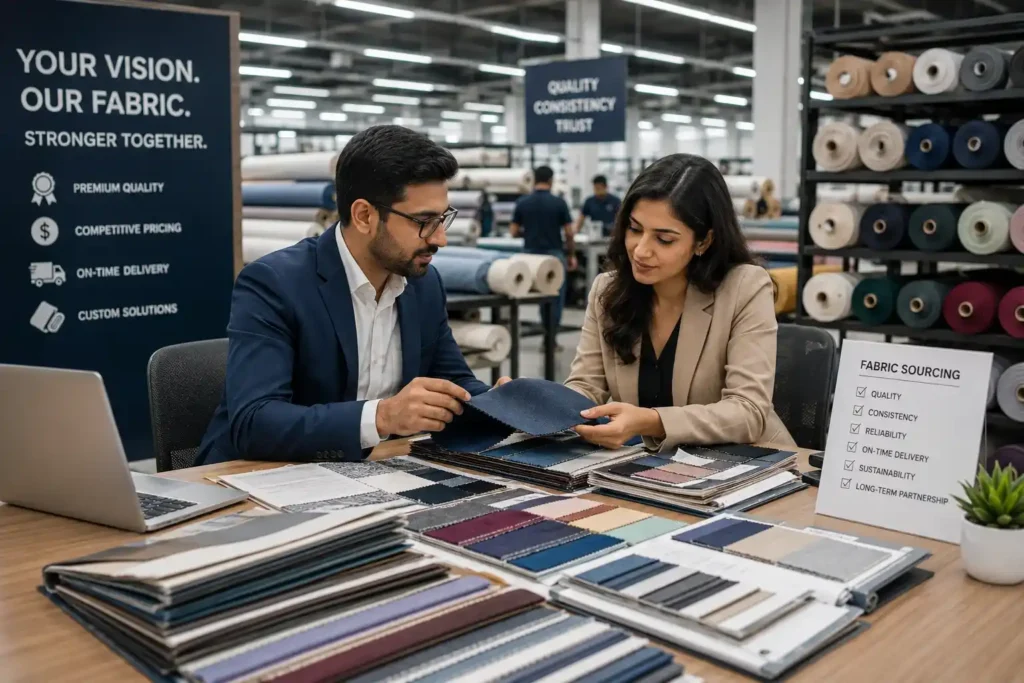
Why Finding the Right Fabric Supplier Is the Most Important Supply Chain Decision
Your fabric supplier determines more than your material cost. They determine whether you can meet your production deadlines, whether your product quality is consistent across batches, whether your garments perform the way your customers expect, and whether your brand can scale without supply chain disruption.
In 2026, the woven fabric market alone is growing toward a projected USD 240 billion globally. India remains one of the world’s most significant textile-producing nations, the largest producer of cotton and jute, and a dominant force in polyester and synthetic fabric manufacturing. Surat, Gujarat, is the concentrated hub for synthetic fabric, digital printing, and saree manufacturing on a global scale.
The breadth of this industry is both its greatest strength and its greatest challenge for buyers. Genuine, high-quality manufacturers exist in abundance. So do undercapitalised intermediaries, quality-inconsistent producers, and outright unreliable operators who are indistinguishable on the surface. The only protection a buyer has is a rigorous evaluation process applied before the first significant order is placed.
Your fabric supplier is not a vendor. They are the foundation of your product. Every sourcing shortcut you take at this stage compounds into quality problems, margin pressure, and customer complaints at a later stage.
Define Your Requirements Before You Start Searching
Fabric Type and Technical Specifications
Start with your specific fabric requirement. Are you sourcing woven polyester RFD for garment production? Viscose for a drape-focused ethnic wear line? Cotton for casual apparel? Digital printing fabric for a D2C fashion brand? Each of these fabric types has a different manufacturing profile and a different supplier ecosystem.
Within your fabric type, define the technical specifications: target GSM (grams per square metre), required fabric width (typically 44, 58, or 60 inches), weave structure (plain, twill, satin), required finish (RFD, dyed, printed), and any specific performance requirements (wrinkle resistance, colour fastness grade, shrinkage tolerance). The more precisely you can articulate these specifications, the more accurately potential suppliers can confirm their capability to meet them.
Volume, MOQ, and Order Frequency
Define your expected order volume and frequency before approaching suppliers. Are you sourcing 500 metres per month for a small D2C brand? 10,000 metres per order for a garment export house? How frequently will you reorder, monthly, seasonally, or ad hoc? Different suppliers are built for different volume profiles, and approaching a large mill with a small-batch requirement creates misaligned expectations that lead nowhere productive.
End-Use Application and Quality Standard
Where to Find Fabric Suppliers in India: The Sourcing Channels
Direct Manufacturer Sourcing
Sourcing directly from a fabric manufacturer eliminates the margin layers added by intermediaries, gives you direct access to production capability information, and creates a relationship built on a genuine understanding of your requirements. For buyers who have defined their specifications clearly, direct manufacturer sourcing produces the best combination of quality assurance, pricing, and long-term reliability.
The challenge with direct manufacturer sourcing is discovery, identifying the right manufacturers across India’s vast and fragmented textile landscape. This requires either industry contacts, trade fair attendance, or targeted digital research combined with factory audits.
B2B Directories and Online Marketplaces
Platforms like IndiaMART, Fibre2Fashion, and TradeIndia index large numbers of fabric suppliers with varying degrees of verification. They are useful for initial discovery, but require careful independent verification of any supplier found there. The volume of listings on these platforms makes thorough vetting essential; listings range from direct manufacturers to brokers presenting themselves as manufacturers.
Use these platforms for discovery and shortlisting, never for order placement without independent verification of the supplier’s actual manufacturing capability and track record.
Textile Trade Fairs and Industry Events
India ITME, Texfair, and Surat’s own textile industry events allow direct, in-person assessment of suppliers and their products. Meeting a manufacturer face-to-face, handling fabric samples, and observing the quality of their display materials gives you information that no online listing can provide. For buyers making significant sourcing commitments, attending at least one relevant trade event before finalising a supplier is strongly recommended.
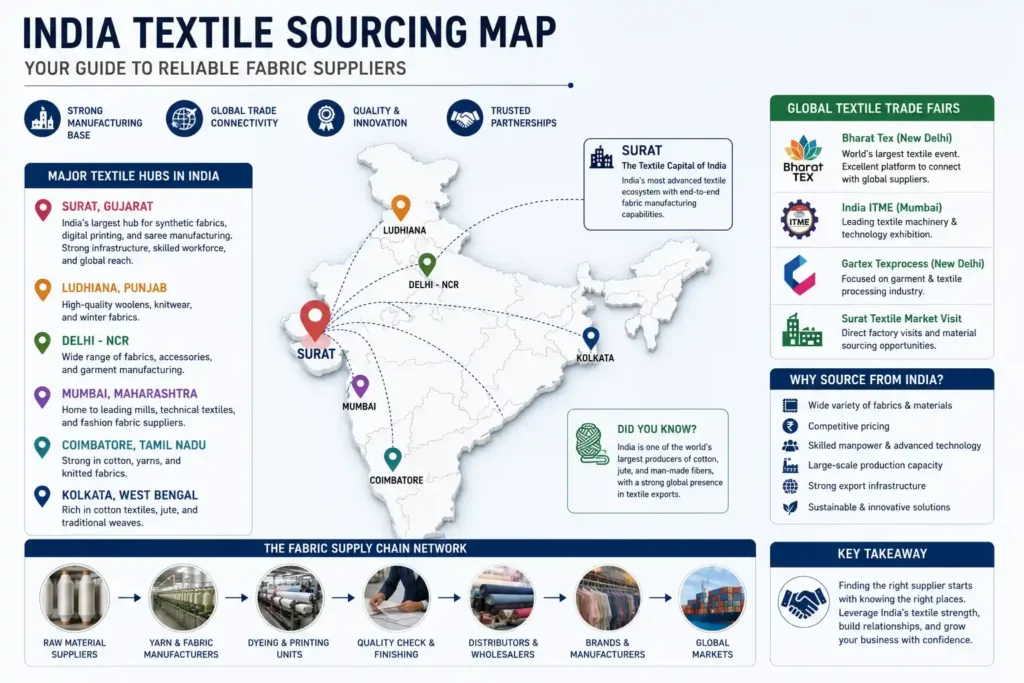
Surat, India's Primary Hub for Synthetic and Printed Fabrics
For buyers sourcing polyester, viscose, digital printing fabrics, or saree-related textiles, Surat is not just one option among many; it is the most concentrated and capable manufacturing ecosystem in India for these specific categories.
Surat’s textile district processes a dominant share of India’s synthetic fabric output. The cluster of manufacturers, dyers, printers, and finishers in Surat means that a Surat-based manufacturer like Ethiraj Fashion operates with direct material access, specialised craftsmen, and production infrastructure built specifically for the fabric types B2B buyers in these categories need. When you source from a Surat-based manufacturer directly, you are sourcing from the geographic heart of the supply chain, not from its periphery.
The 8-Point Supplier Evaluation Framework, Before You Place Any Order
1. Manufacturing Capability Verification
Confirm that the supplier actually manufactures the fabric themselves rather than brokering it from a third party. Ask for details of their production facility, location, machinery types, production capacity, and the specific fabric types they manufacture in-house. Request a video tour or arrange a factory visit for significant orders. A genuine manufacturer will accommodate this request without hesitation.
Ask specifically: What is your in-house production capacity for this fabric type per month? Can you share your facility location and basic machinery details?
2. Quality Control Systems
3. Sample Performance
4. MOQ and Pricing Transparency
5. Batch-to-Batch Consistency
6. Delivery Reliability
7. Communication Quality
8. References and Track Record
Request references from existing B2B clients in a similar buyer category to yours, a fashion brand if you are a fashion brand, an export house if you are an exporter. Contact these references directly and ask specifically about quality consistency across multiple orders, delivery reliability, and how the supplier handles problems when they arise.
Apply all eight criteria before your first bulk order. The 2 to 3 weeks you spend on rigorous evaluation before ordering will save months of supply chain problems after. A reliable supplier will welcome this level of scrutiny; it is the sign of a serious, long-term buyer they want to work with.
Red Flags, 5 Warning Signs of an Unreliable Fabric Supplier
Experienced buyers develop an instinct for identifying unreliable suppliers early. For buyers who are new to B2B fabric sourcing, these five warning signs should trigger immediate caution.
Warning: The supplier refuses or deflects a factory visit or facility verification request. Any legitimate manufacturer welcomes buyers to see their production environment. Refusal or consistent deflection means either the facility does not exist as described or the quality does not match the marketing.
Warning: Pricing seems significantly lower than comparable suppliers for the same specification. In fabric manufacturing, as in most industries, price reflects cost. A price 30 to 40 percent below market for a specified quality level is almost always an indicator of a different (lower) actual quality, unstated substitutions in raw materials, or an intermediary misrepresenting themselves as a manufacturer.
Warning: The sample quality does not match the delivered bulk order. This is the most frequently reported problem in Indian fabric sourcing and the most expensive. The sample represents best-case production; the bulk represents normal production. Always specify in your purchase order that bulk quality must match the approved sample within stated tolerances, and build a quality audit into your receiving process.
Warning: Vague or evasive answers to specific technical questions. If a supplier cannot or will not answer specific questions about GSM, weave structure, shrinkage tolerance, or QC process with operational specifics, they are telling you something important about the reliability of their production systems.
Warning: No written documentation offered. Legitimate suppliers provide written quotations, sample approval records, purchase order confirmations, and dispatch documents as a matter of course. A supplier who operates on verbal agreements and WhatsApp messages only is not operating a professional manufacturing business, and verbal commitments are unenforceable when problems arise.
Sourcing by Fabric Type, Matching Supplier to Application
Different fabric types require different supplier capabilities and evaluation criteria. Here is a practical guide for the most commonly sourced fabric categories.
RFD Polyester: Look for manufacturers with in-house heat setting capability, consistent GSM control, and experience supplying garment manufacturers at production scale. RFD polyester quality is primarily evaluated through GSM consistency, surface uniformity, and dimensional stability post-wash. Ethiraj Fashion’s Polyester RFD Fabric is produced with these specific garment manufacturer requirements built into every production batch.
Digital Printing Fabric (Polyester, Viscose, Cotton): Source from manufacturers who combine RFD fabric production with in-house digital printing capability. Sourcing fabric and printing from two separate suppliers introduces quality risk at the interface, colour inconsistency, fabric distortion during printing, and batch mismatch. Ethiraj Fashion’s Digital Printing service operates on the same substrate we manufacture, eliminating this interface risk entirely.
Viscose RFD: Viscose requires careful evaluation for consistent drape weight, GSM accuracy, and colour absorbency uniformity, all of which are highly sensitive to production process consistency. Ethiraj Fashion’s Viscose RFD Fabric serves fashion brands and ethnic wear manufacturers who need reliable drape quality across multi-batch production runs.
Cotton Digital Printing: Cotton’s natural fibre characteristics require reactive dye printing rather than the disperse dye sublimation used for polyester. Verify that your digital printing supplier has the correct process for your specific fabric substrate; the chemistry differs significantly between fibre types. Ethiraj Fashion’s Cotton Digital Printing Fabric is produced with substrate-specific process parameters for accurate colour reproduction on cotton.
First-Time B2B Fabric Buyers , A Starter Guide
If you are sourcing fabric for your business for the first time, whether you are launching a D2C fashion brand, building a boutique collection, or scaling an Instagram-based apparel business, the B2B fabric sourcing process has specific dynamics that differ from consumer buying.
The most important mindset shift is understanding that fabric suppliers are not retailers. They do not maintain displays of products you browse and select. They manufacture to specification based on your requirements. This means your first conversation with a supplier is not ‘show me what you have’ but ‘here is what I need, can you supply it?’
Start with a clear written brief: fabric type, GSM range, colour or print requirements, target quantity, and timeline. Share this with three to five shortlisted suppliers and evaluate the quality of their responses. Suppliers who respond with specific, detailed, and helpful answers to your brief are demonstrating the communication and technical competence you want in a manufacturing partner.
Place a sample order, not an immediate bulk order, before committing to a significant volume. Evaluate the sample against your brief, assess the supplier communication during the sample process, and confirm that the lead time and logistics work for your production cycle.
Ethiraj Fashion’s make-to-order and custom quality development service is specifically designed for exactly this buyer type. Whether you need a custom GSM specification, a specific fabric construction, or digitally printed fabric developed to your design, our team guides you through the process from specification to sample to bulk production, without requiring you to already know every technical detail upfront.
Building a Long-Term Supplier Relationship: The Smart Approach
The goal of fabric sourcing is not finding a supplier for one order. It is finding a manufacturing partner for the long term, someone whose production becomes predictable, whose quality you can rely on without intensive re-evaluation at every order, and whose business grows alongside yours.
Long-term supplier relationships produce compounding advantages over time. Suppliers who understand your quality requirements produce better results on subsequent orders than on the first. Pricing typically improves with volume consistency and payment reliability. Lead times shorten as the supplier allocates capacity based on your predictable order pattern. And problems, when they do arise, get resolved faster and more fairly when both parties have invested in the relationship.
Building this kind of relationship requires consistency from your side as well. Communicate your requirements clearly and in writing. Pay on agreed terms. Provide feedback on received orders, both positive and when quality issues arise. Give the supplier enough lead time to produce well rather than demanding impossible timelines. A buyer who behaves as a genuine long-term partner earns the kind of service and priority that purely transactional buyers never receive.
The best fabric suppliers in India are not looking for buyers. They are looking for partners. A buyer with clear requirements, consistent orders, and reliable payment is a more valuable account than any spot buyer, and the best manufacturers treat them accordingly.
Why Ethiraj Fashion Is the Fabric Supplier Your Business Deserves
Ethiraj Fashion is a Surat-based fabric manufacturer and digital printing specialist with over a decade of experience serving fashion brands, garment manufacturers, exporters, and corporate clients across India and globally. Located at 204, Kohinoor House, Ring Road Branch, Surat, at the heart of India’s synthetic fabric manufacturing district, our operations combine RFD fabric production and digital printing in a single facility.
This integration is our most significant structural advantage for buyers who need both fabric and printed fabric. You source the RFD base fabric and the digital printing from the same manufacturer, with the same quality control standard applied to both processes. The batch consistency, colour accuracy, and fabric behaviour that result from this integrated approach are impossible to replicate when sourcing fabric and printing from separate suppliers.
Our fabric range covers the full spectrum of B2B needs: Polyester RFD for garment production, Polyester Digital Printing for fashion collections, Viscose RFD for drape and ethnic wear, Viscose Digital Printing for premium fashion, and Cotton Digital Printing for casualwear and everyday apparel.
Our make-to-order and custom quality development service means that buyers with specific fabric requirements, a custom GSM, a particular weave construction, or a proprietary print design, can work with our technical team to develop the exact fabric their production requires. We do not require you to fit your brand into our standard catalogue. We build the fabric around your specifications.
Every order at Ethiraj Fashion begins with a sample approval process. Bulk production proceeds only after the buyer confirms sample compliance. And every batch is quality-checked against the approved sample before dispatch, the protection against sample-bulk mismatch that every B2B buyer needs, and too few suppliers deliver consistently.
Conclusion: Your Supply Chain Starts with One Right Decision
Finding a reliable fabric supplier is not a task you complete once and file away. It is a decision you make at the beginning of every significant production relationship, and the quality of that decision determines the quality of every product your business makes.
The framework in this guide gives you the tools to evaluate any supplier systematically: defining your requirements before you search, using the right discovery channels, applying the 8-point evaluation framework, recognising warning signs before they become problems, and building the kind of relationship that compounds in value over time.
The fabric sourcing landscape in India in 2026 offers buyers more choice, more transparency, and more information than ever before. The buyers who thrive in this environment are not the ones who find the lowest price. They are the ones who identify the right manufacturing partner, the one whose quality, capability, and communication reliably support their production, and build a relationship that grows alongside their business.
Frequently Asked Questions
Start by clearly defining your fabric requirements, type, GSM, finish, and order volume. Then shortlist direct manufacturers through Surat or relevant textile hubs, request samples from at least three suppliers, and apply the 8-point evaluation framework before committing to a bulk order. Prioritise suppliers who respond specifically to your brief, offer factory verification, and provide written quotations with no hidden charges.
MOQ varies significantly by supplier type. Large mills typically require 1,000 metres or more per fabric type. Medium-sized manufacturers like Ethiraj Fashion can accommodate smaller minimum quantities for specific fabric types, particularly for custom development and make-to-order service. Always confirm MOQ before the first supplier conversation to avoid misaligned expectations.
Surat is India’s primary hub for synthetic fabrics, polyester, viscose, digital printing, and saree-related textiles. The concentration of manufacturers, dyers, and printers in a single geographic cluster means shorter lead times, lower logistics costs, and better access to specialised expertise in synthetic fabric categories. For buyers sourcing polyester RFD, viscose, or digital printing fabric, Surat is the most strategically advantaged sourcing location in India.
A fabric manufacturer produces fabric itself, with their own machinery, materials, and production processes. A fabric supplier may be a manufacturer, a wholesaler (who buys from manufacturers and resells), or a broker (who sources from manufacturers on your behalf). For quality consistency, batch reliability, and best pricing, sourcing directly from a manufacturer is always preferable. Always verify which category a potential supplier falls into.
Specify in your purchase order that bulk quality must match the approved sample within stated tolerances. Request samples from multiple production batches before bulk order confirmation. Conduct a receiving quality check on every bulk delivery against the approved sample. And choose suppliers who use a formal sample approval process before initiating bulk production, as Ethiraj Fashion does for every order.
Yes. Ethiraj Fashion’s make-to-order and custom quality development service is specifically suited to fashion startups, D2C brands, and boutique owners who need fabric developed to their specifications rather than selected from a standard catalogue. Our team guides first-time B2B buyers through the specification, sample, and production process at every step.
Ethiraj Fashion supplies Polyester RFD Fabric (for garment manufacturers needing a reliable production base), Polyester Digital Printing Fabric (for fashion brands wanting custom printed designs), Viscose RFD (for occasion wear and ethnic wear needing fluid drape), Viscose Digital Printing (for premium printed fashion), and Cotton Digital Printing (for casualwear and everyday apparel). Contact the team with your specific application, and they will recommend the most suitable fabric type and specification.