
Introduction
If you are sourcing fabric for a fashion brand, a garment manufacturing line, or a bulk apparel order, chances are that polyester is already part of your supply chain, or it should be. It is the most produced synthetic fibre in the world, and in 2026, it accounts for over 54% of global fibre consumption. But despite its ubiquity, few B2B buyers have a complete picture of what polyester fabric actually is, what types are available, and which variant best serves their specific production application.
This guide answers all of that, written specifically for fashion brands, garment manufacturers, boutique owners, exporters, and corporate buyers in India who are making sourcing decisions in 2026. By the time you finish reading, you will understand polyester fabric at the level of detail your business decisions require.
At Ethiraj Fashion, Surat, we manufacture and supply polyester RFD fabric and polyester digital printing fabric for fashion brands, garment manufacturers, exporters, and corporate clients across India and globally. Over a decade of manufacturing expertise backs every metre we supply.
Polyester Fabric: The Global Market Reality in 2026
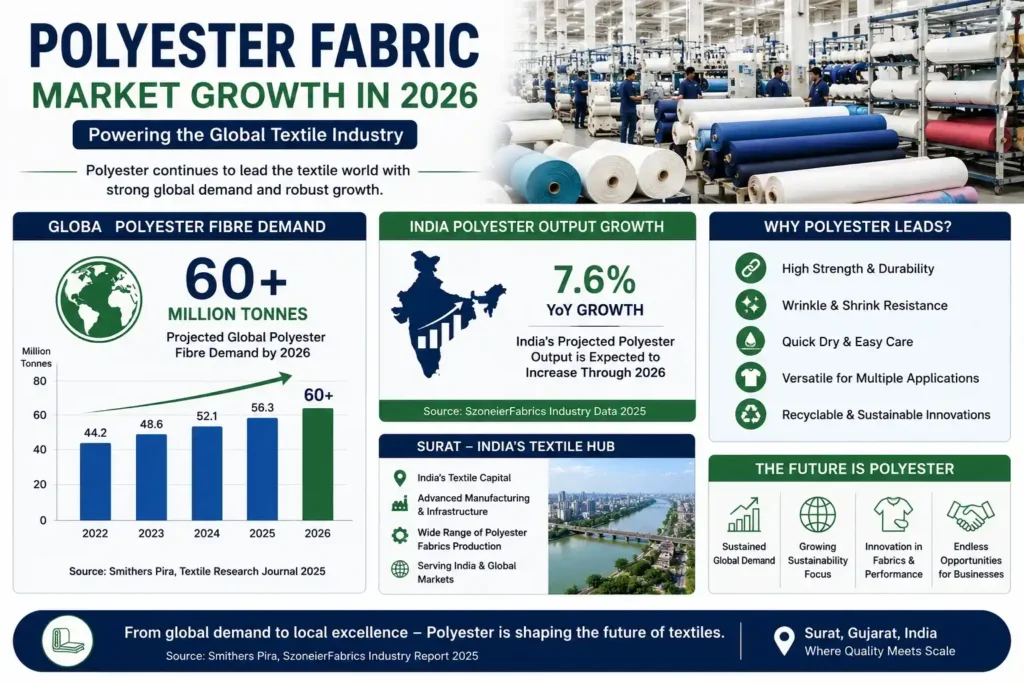
Polyester is not just the most popular synthetic fabric. It is the most produced textile fibre of any kind in the world, natural or synthetic. Global demand for polyester fibres is projected to exceed 60 million tonnes by 2026 (Smithers Pira), and India’s polyester output is growing at 7.6% year on year, driven by demand for blended fabrics and technical wear across Asia and the Middle East (SzoneierFabrics Industry Report, 2025).
India is a central player in this growth. As the world’s second-largest textile producer, India’s polyester manufacturing ecosystem, concentrated heavily in Gujarat and Surat, supplies fashion brands, garment exporters, and institutional buyers across the domestic and international market. Surat, India’s textile capital, processes and manufactures polyester fabrics at scale, with in-house dyeing, printing, and finishing capabilities that serve buyers from small D2C fashion startups to large-volume export accounts.
60 million+ tonnes, projected global polyester fibre demand by 2026. Source: Smithers Pira, Textile Research Journal 2025
7.6% YoY growth, India’s projected polyester output is expected to increase through 2026. Source: SzoneierFabrics Industry Data 2025
What Is Polyester Fabric? A Clear, Technical Definition
Polyester is a synthetic fabric derived from polyethylene terephthalate (PET), a polymer produced through a chemical reaction between ethylene glycol and terephthalic acid, both petroleum derivatives. The resulting polymer is melted and extruded through fine spinnerets to form continuous filament fibres, which are then spun, woven, or knitted into fabric.
At the molecular level, polyester’s strength comes from its polymer chain structure, long, tightly bonded chains that give the fabric its characteristic durability, resistance to stretching, and dimensional stability. The same PET chemistry used to make polyester fabric is used to produce plastic bottles, which is why recycled polyester (rPET) can be created from post-consumer plastic waste, a growing and important segment of the 2026 textile market.
How Polyester Is Made: The Production Process
The production of polyester fabric begins with polymerisation, combining the raw chemical inputs under heat to form PET resin. This resin is melted and extruded through spinnerets (tiny holes) to create long, thin fibres. These fibres are drawn (stretched) to align the polymer chains and increase strength, then either texturised for a softer hand feel or left flat for a smoother finish.
The resulting fibre is then processed into yarn and subsequently woven or knitted into fabric. After fabric formation, the raw grey fabric goes through finishing processes, scouring, heat setting, and (if required) dyeing or printing, before it is ready for garment production. Understanding this process is important for B2B buyers because it explains why different polyester fabrics have different hand feels, weights, and performance characteristics.
What Is RFD Polyester Fabric? (Essential for B2B Buyers)
RFD stands for Ready for Dyeing, and it is the most important format for garment manufacturers and fabric buyers to understand. RFD polyester fabric is a greige (unfinished) fabric that has been through initial cleaning and preparation processes (scouring and heat setting) but has not yet been dyed or printed. It is the blank canvas of the fabric supply chain.
For B2B buyers, RFD fabric offers the greatest flexibility and the best value. You source the fabric in its clean, uniform state and apply your own dyeing or printing to create the exact colour, pattern, or finish your collection requires. This is the format used by virtually every garment manufacturer in India’s textile supply chain, and it is the core product category at Ethiraj Fashion.
Ethiraj Fashion’s Polyester RFD Fabric is manufactured in Surat with strict quality control at every stage, consistent GSM, clean surface finish, and uniform fabric width, giving buyers the reliable base they need for predictable dyeing and printing results. Our full RFD fabric range also includes viscose and cotton RFD options for buyers who work across multiple fabric types.
For garment manufacturers: Always specify your target GSM range, fabric width, and end-use application when ordering RFD polyester. These three parameters determine the most suitable weave structure and finishing specification for your production requirements.
Types of Polyester Fabric: A Complete Classification
Not all polyester fabrics are the same. The weave structure, fibre format, and finishing process create distinct fabric types with different performance characteristics, drapes, and end-use applications. Understanding these types is essential for B2B buyers making sourcing decisions.
1. Woven Polyester Fabric
Woven polyester is produced by interlacing warp and weft yarns at right angles on a loom. The result is a stable, structured fabric with excellent dimensional stability; it retains its shape under tension and through repeated washing. Woven polyester is the most versatile type and the most widely used in apparel manufacturing.
Within woven polyester, sub-categories include plain weave (smooth surface, good for printing), twill weave (diagonal texture, excellent drape), and satin weave (smooth, lustrous surface ideal for occasion wear). For fashion brands and garment manufacturers, woven polyester represents the most reliable sourcing format for consistent, repeatable production.
2. Knit Polyester Fabric
Knit polyester is produced by interlooping yarn, creating a fabric with inherent stretch and recovery. It is softer to the touch than woven polyester and conforms naturally to the body, making it the preferred choice for activewear, sportswear, athleisure, and comfortable casual apparel. Interlock knit, jersey knit, and mesh are common knit polyester variants.
For fashion startups and D2C brands building activewear or comfort-focused collections, knit polyester offers the stretch, recovery, and moisture-wicking performance that modern apparel buyers expect.
3. Polyester Satin
Polyester satin uses a satin weave structure, where warp threads float over multiple weft threads, to create a smooth, lustrous surface on one side of the fabric. The result is a fabric with excellent drape and a visual richness that is closely associated with luxury occasion wear, bridal garments, and high-end fashion.
In India’s fashion market, polyester satin is widely used for sarees, evening gowns, bridal wear, and premium kurtas. Its smooth surface also makes it an excellent base for digital printing, as colours appear vibrant and clear without the texture interference of more textured weaves.
4. Polyester Chiffon
Polyester chiffon is a lightweight, sheer, and flowing fabric produced from fine twisted polyester yarns in a loose plain weave. It mimics the appearance and drape of silk chiffon at a fraction of the cost and with significantly better durability. It is widely used in Indian ethnic wear, particularly for sarees, dupattas, and flowing silhouette garments.
For boutique owners and fashion brands producing occasion wear, polyester chiffon delivers elegant movement, excellent colour saturation for printing, and strong retail price appeal, making it one of the most commercially valuable polyester fabric types in the Indian market.
5. Recycled Polyester (rPET)
Recycled polyester, produced from post-consumer PET plastic waste, primarily plastic bottles, has grown from a niche sustainability choice to a mainstream sourcing option in 2026. According to the Textile Exchange, recycled polyester can reduce carbon emissions by up to 70% compared to virgin polyester, making it a significant tool for brands facing sustainability reporting requirements or export buyer ESG standards.
For Indian fashion brands exporting to Europe, the USA, or Australia, rPET increasingly appears as a buyer requirement rather than a premium option. Buyers specify GRS (Global Recycled Standard) certification as a sourcing criterion. Understanding and sourcing rPET is becoming a commercial necessity for export-focused Indian apparel manufacturers.
6. Polyester Blends, Poly-Cotton and Poly-Viscose
Polyester is frequently blended with other fibres to combine the strengths of each. Poly-cotton blends (typically 65% polyester, 35% cotton) offer polyester’s durability and wrinkle resistance alongside cotton’s breathability and natural comfort, the most widely used fabric blend in corporate uniform manufacturing. Poly-viscose blends combine polyester’s strength with viscose’s fluid drape and soft touch, making them popular for fashion-forward occasion wear and premium ready-to-wear.
Ethiraj Fashion’s fabric range supports buyers across all three primary material choices. Alongside polyester RFD fabric, we manufacture viscose RFD fabric and cotton digital printing fabric, giving buyers working with multiple fabric types a single, reliable manufacturing partner for their entire fabric sourcing needs.
Key Properties and Benefits of Polyester Fabric
The commercial dominance of polyester in global textile production is not accidental. Its property profile makes it uniquely suited to the demands of modern apparel manufacturing and B2B supply chains.
Exceptional durability and tensile strength. Polyester fibres are among the strongest available in textile production. They resist tearing, stretching, and abrasion, meaning garments made from polyester maintain their shape and finish across significantly more wash and wear cycles than most natural fibre alternatives. For corporate uniform buyers and institutional clients, this durability directly reduces the total cost of ownership.
Wrinkle resistance and dimensional stability. Polyester’s polymer chain structure resists the permanent deformation that causes wrinkling in natural fibres. Garments retain their pressed appearance through extended wear and storage, a critical property for corporate wear, formal apparel, and hospitality uniforms where presentation standards are non-negotiable.
Excellent colour fastness for dyeing and printing. Polyester’s structure accepts dyes (specifically disperse dyes) with excellent colour fastness, the ability to retain colour intensity through repeated washing and UV exposure. For digital printing applications, polyester’s smooth surface and dye affinity produce sharper detail and more vibrant colour reproduction than natural fibres.
Low moisture absorption and quick drying. Polyester absorbs approximately 0.4% of its weight in moisture, compared to cotton’s 8%. This hydrophobic property means polyester garments dry rapidly after washing or exposure to moisture, which is important for activewear, sportswear, and travel garments where quick-dry performance is a functional requirement.
Ease of care and low maintenance. Polyester is machine washable, does not require special detergents, and does not shrink or stretch under normal washing conditions. For end consumers, this translates into longevity and convenience. For B2B buyers, it means the garments you produce will maintain their quality in customers’ hands, reducing returns and brand complaints.
Cost efficiency and availability. Polyester is significantly less expensive than natural fibres on a per-metre basis for equivalent weight and construction. For brands managing margin pressure, polyester fabric delivers excellent performance at a cost basis that allows healthy retail margins.
For B2B buyers in 2026, polyester fabric’s combination of durability, printability, ease of care, and cost efficiency makes it the most commercially rational base fabric for a wide range of apparel categories.
Polyester Fabric Uses, Industry-by-Industry Application Guide
Understanding where polyester performs best helps B2B buyers specify the right type and weight for their production application.
Fashion apparel and ethnic wear: Polyester, satin, chiffon, and woven polyester are extensively used in sarees, kurtas, occasion wear, and party wear. Their excellent printability makes them the preferred substrate for digital printing, enabling fashion brands to achieve high-definition custom designs on fabric at a production scale.
Activewear and sportswear: Knit polyester with moisture-wicking treatment is the industry standard for athletic apparel. Its quick-dry properties, stretch-recovery characteristics, and colour fastness make it functionally superior to natural fibres for performance garments.
Corporate uniforms and institutional wear: Poly-cotton blends are the dominant fabric choice for corporate uniforms, school uniforms, hospitality wear, and workwear. The combination of polyester’s durability and wrinkle resistance with cotton’s breathability serves the comfort and presentation requirements of institutional buyers simultaneously.
Home textiles: Polyester’s durability and ease of care extend its use well beyond apparel into curtains, upholstery fabrics, bedding, and decorative textiles, a growing category for Surat-based manufacturers supplying to interior brands and home furnishing exporters.
Technical and industrial textiles: High-tenacity polyester is used in geotextiles, conveyor belts, ropes, and protective wear, applications where tensile strength and environmental resistance are primary requirements.
Polyester vs Viscose vs Cotton, Which Should You Source?
The right fabric choice for any garment application depends on the performance requirements, the end consumer profile, and the production economics. Here is a direct comparison of the three primary fabric types available from Ethiraj Fashion.
Property | Polyester | Viscose | Cotton |
Durability | Excellent, highest | Moderate | Good |
Drape | Good to excellent | Excellent | Moderate |
Breathability | Low (improves in blends) | High | Excellent |
Moisture Absorption | Very low (quick dry) | High | High |
Wrinkle Resistance | Excellent | Low | Low |
Print Quality | Best, vivid, and sharp | Good | Good |
Colour Fastness | Excellent | Good | Good |
Cost (Per Metre) | Most affordable | Mid-range | Highest |
Best Applications | Fashion, uniforms, print | Ethnic, draped wear | Casualwear, daily wear |
Ethiraj Fashion manufactures all three: Polyester RFD, Viscose RFD, and Cotton Digital Printing Fabric, giving you a single sourcing partner for your entire fabric range, with consistent quality standards across all three material categories.
Why Polyester Is the Best Base for Digital Printing
Digital textile printing has transformed how fashion brands develop and produce printed fabrics. Instead of minimum order quantities of hundreds of metres for traditional screen printing, digital printing allows high-definition, custom designs at small sample runs and large bulk quantities equally, making it accessible to D2C startups and large brands alike.
Polyester is the ideal substrate for digital printing for three technical reasons. First, polyester’s surface smoothness allows inkjet print heads to deposit ink droplets with precision, producing sharp edges, fine detail, and accurate colour reproduction. Second, disperse dye sublimation printing on polyester produces colours that become part of the fibre itself rather than sitting on the surface, resulting in exceptional wash fastness and UV resistance. Third, polyester’s dimensional stability means the fabric does not distort during the printing process, maintaining pattern registration across large print runs.
Ethiraj Fashion’s digital printing service is specifically optimised for polyester substrates. Our advanced digital printing technology delivers rich tones, sharp detailing, and balanced texture across both standard and custom colour profiles. For fashion brands needing unique printed fabrics for their collections, our polyester digital printing fabric range offers the full combination of print quality and fabric consistency that production-scale brands require.
For D2C fashion startups: Digital printing on polyester is the most practical route to unique, branded printed fabrics at manageable minimum order quantities. You get the look of a custom-designed collection fabric without the screen printing minimum order requirements that make small-batch production economically unviable.
How to Evaluate Polyester Fabric Quality Before Bulk Ordering
Quality inconsistency is the most common and most damaging problem in bulk fabric sourcing. Here is a practical framework for evaluating polyester fabric quality before committing to a large order.
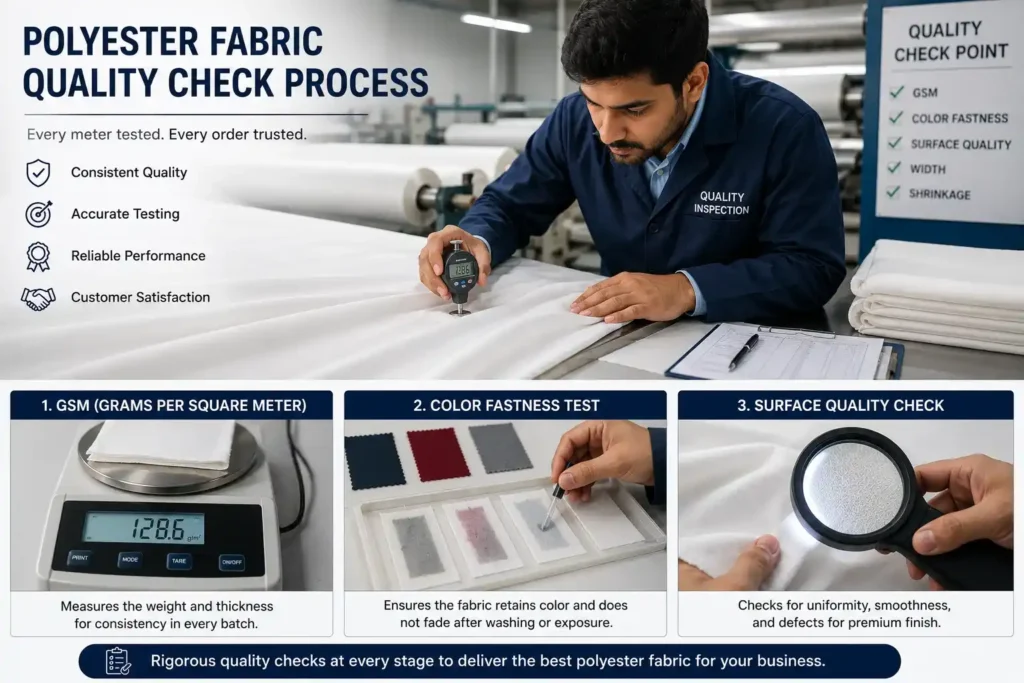
GSM (grams per square metre) verification. GSM is the primary indicator of fabric weight and density. Request a physical swatch, weigh a 10cm x 10cm sample, and calculate the GSM to verify it matches the supplier’s specification. Deviations of more than 5% from the specified GSM indicate inconsistent manufacturing.
Surface finish and hand feel. RFD polyester should have a clean, even surface without visible defects, uneven weave density, or irregular finishing. Request a minimum 1-metre sample before bulk order confirmation. Assess the surface under natural light for any sheen inconsistency or fabric distortion.
Dimensional stability test. Wash a sample at the intended garment care temperature and measure for shrinkage. Quality polyester RFD fabric should show less than 1% dimensional change after washing. Greater shrinkage indicates inadequate heat setting during finishing.
Colour fastness for printed or dyed fabric. Wash a printed or dyed sample 3 to 5 times and assess colour change against the original. Quality digital printing on polyester should show no visible fading and no colour transfer onto a white fabric rubbed against the surface.
Supplier credibility and production consistency. Request samples from 3 separate production batches rather than a single sample. Batch-to-batch consistency is the most reliable indicator of a manufacturer’s production quality control systems.
At Ethiraj Fashion, every bulk order begins with a confirmed sample approval process. Buyers receive samples from the specific production batch that will fulfil their order, ensuring the fabric you approve is the fabric you receive.
Why Ethiraj Fashion Is Your Polyester Fabric Sourcing Partner in Surat
Ethiraj Fashion is a Surat-based fabric manufacturer and digital printing specialist with over a decade of experience supplying fashion brands, garment manufacturers, exporters, and corporate clients across India and globally. Our manufacturing facility at 204, Kohinoor House, Ring Road Branch, Surat, operates with precision textile machinery, an expert technical team, and strict quality control protocols at every stage of production.
Our core competency is the combination of RFD fabric manufacturing and digital printing in a single facility. This means buyers who source polyester RFD fabric from Ethiraj Fashion can also commission printed fabric on the same substrate, with colour consistency and fabric behaviour that is guaranteed to align because both processes originate from the same manufacturing source.
Our fabric range covers the full spectrum of B2B buyer needs: Polyester RFD Fabric for garment manufacturers, Polyester Digital Printing Fabric for fashion brands, Viscose RFD Fabric for drape and occasion wear, Viscose Digital Printing Fabric for ethnic and premium fashion, and Cotton Digital Printing Fabric for casualwear and everyday apparel.
For fashion startups requiring end-to-end production support, our make-to-order and custom quality development services allow you to specify your exact fabric requirement and receive a fabric developed to your production standard, not a generic catalogue selection.
Conclusion: Source Smarter. Build Better.
Polyester fabric is not a commodity choice. It is a strategic material decision. The type you choose, the quality you specify, and the manufacturer you partner with directly determine the consistency, performance, and profitability of the garments you produce.
From woven RFD polyester for garment production to digital printing polyester for fashion brand collections, from poly-viscose blends for occasion wear to rPET for export-bound sustainability requirements, the right polyester sourcing decision begins with understanding exactly what you need and working with a manufacturer who can deliver it at scale, with consistency, and with the flexibility your brand requires.
Surat is India’s textile manufacturing heart, and Ethiraj Fashion operates at its centre. Over a decade of manufacturing expertise, a full range of RFD and digitally printed fabrics, precision machinery, and a commitment to quality that does not vary between sample and bulk order, this is what separates a manufacturing partner from a fabric supplier.
Frequently Asked Questions
Polyester fabric is a broad term for any fabric made from polyester fibres. RFD (Ready for Dyeing) polyester fabric specifically refers to polyester that has been manufactured, scoured, and heat-set but not yet dyed or printed. RFD is the standard sourcing format for garment manufacturers and fabric buyers who want to apply their own colours or prints. Ethiraj Fashion supplies polyester RFD fabric from its Surat manufacturing facility.
Woven polyester in a plain or satin weave is the best substrate for digital printing. Its smooth surface allows precise ink deposition, and disperse dye sublimation printing on polyester produces exceptional colour vibrancy, sharp detail, and excellent wash fastness. Polyester satin gives the most visually striking printed result for fashion and occasion wear applications.
For apparel, polyester fabric typically ranges from 60 GSM (lightweight chiffon) to 200 GSM (structured woven fabric for formalwear). Fashion and ethnic wear typically use 80 to 120 GSM. Corporate uniforms and workwear typically use 130 to 180 GSM for durability and a structured appearance. Always specify your target GSM alongside your end-use application when requesting samples or placing bulk orders.
Yes, extensively. Polyester satin and polyester chiffon are among the most widely used fabrics for Indian ethnic wear. Their excellent drape, vibrant colour saturation, and strong print quality make them ideal for sarees, dupattas, kurtas, and occasion wear. Ethiraj Fashion supplies polyester fabrics specifically suited to Indian fashion brands and ethnic wear manufacturers.
Recycled polyester (rPET) is produced from post-consumer PET plastic waste, typically plastic bottles. It offers the same performance properties as virgin polyester at up to 70% lower carbon emissions. For Indian exporters supplying to European or North American buyers, GRS-certified rPET is increasingly specified as a sourcing requirement to meet sustainability standards. Understanding and sourcing rPET is a growing commercial necessity for export-focused Indian garment manufacturers.
Ethiraj Fashion supports both bulk production orders and smaller custom development quantities. For specific MOQ and pricing information based on your fabric type, GSM requirement, and order volume, contact the team directly at ethirajfashion.com/contact-us/ or WhatsApp +91-9825572536. Sample development is available before bulk order confirmation.
Yes. Ethiraj Fashion supplies fabric to garment manufacturers, fashion brands, and exporters both domestically across India and internationally. Our pan-India and global supply network, precision manufacturing standards, and custom fabric development capability make us a suitable sourcing partner for international buyers requiring consistent quality at production scale.